In March 2018 a teacher at a charter school in Lehi asked if I could help with their Mary Poppins. She could get eight wireless mics. I said yes, came to rehearsals the week before, and at one point ran three shows in a single day.
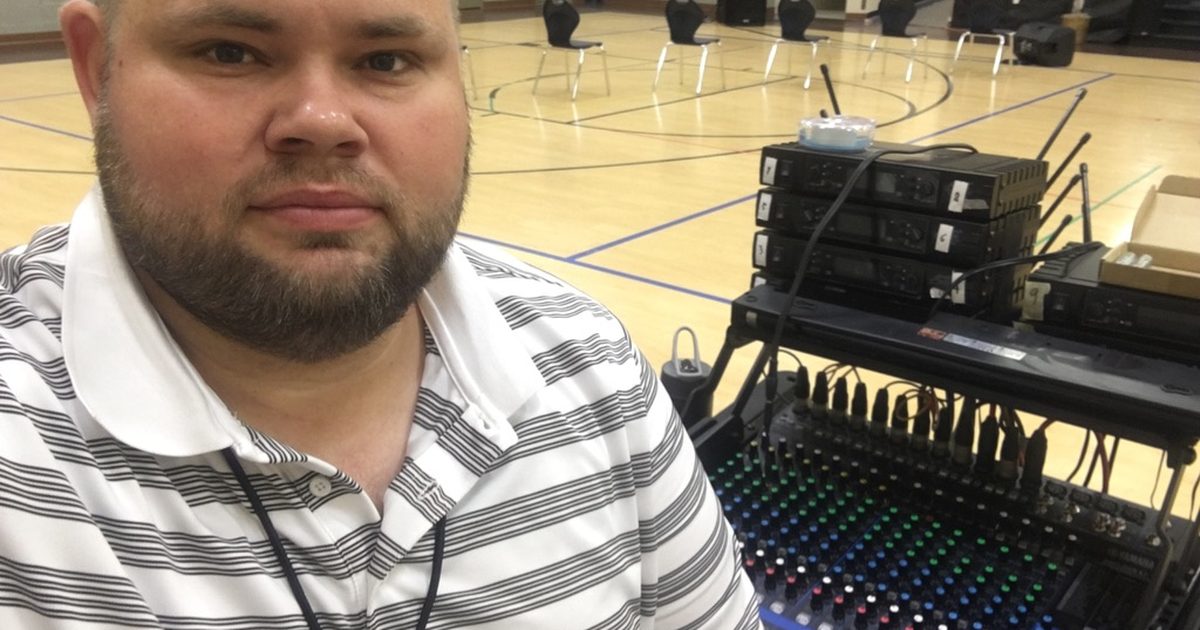
I'd been mixing shows for twenty years by then. I had never been the outside sound guy a school called in. I made a lot of mistakes on that one, and the biggest is sitting right there in the photo.
The Mistake Is in the Photo
Look at the receivers behind me. They're stacked on top of each other, and every antenna is a few inches from the next one. People in my business call that an antenna farm, and it isn't a compliment.
Wireless receivers packed that close step on each other. Each one is trying to hear its own mic, and its neighbors are right there in its ear. The mics start cutting out, and they don't pick a quiet moment to do it.
The gear was fine. The setup was mine, and the setup was the problem.
What I Do Now
Every school show since then has been better because of that one. Here's what changed.
- Antennas go up and apart. Away from the receivers, away from each other, with a clear line to the stage. If the antenna can't see the performer, the mic is going to struggle.
- I scan in the room the show is in. The only radio picture that matters is the one in your gym or auditorium on show week. When I'm running a show, I check what's already in the air there and set the mics around it.
- I walk the stage before anyone sings. Every mic gets carried to every corner the cast will use, while I watch the receiver. It's a lot better to find the dead spot on Tuesday than on opening night.
I've Seen the Same Pile Since
Later on an elementary school called me about Newsies Jr. They had rented mics from a big company, and the kids kept dropping out. When I walked in, there it was: receivers stacked together, antennas crowded on top of each other, nothing coordinated.
I knew exactly what I was looking at, because I'd built the same pile myself. I brought my own racks, set the frequencies in their gym, and the show went on. There's more on that one on my school theater page.
If Your Mics Keep Cutting Out
It's probably not the mics. Before you buy anything, look at where the receivers are sitting and where the antennas are pointing.
I put a short lesson on this in my free sound training. It's called "Wireless mics: the four ways they quit," and it takes about three minutes. Your student crew can watch it before the next rehearsal. If you want the longer version, I wrote up which wireless frequencies work in Idaho too.
And if you'd like someone to look at your setup, ask me. I'll tell you what I'd check first.