Every corporate AV quote in front of you right now probably has the phrase “full production” on it somewhere. The number underneath it might be three thousand dollars or thirty. Both vendors can be quoting honestly, because nobody ever agreed on what the phrase covers.
So you are not comparing prices. You are comparing five different scopes that happen to share a label.
Here is what actually moves between one quote and the next.
The Five Line Items That Move
Strip the language off any two corporate quotes and the difference lands in the same five places nearly every time.
| Line item | AV support | Full production |
|---|---|---|
| Sound | Speakers, mics, a mix for the room | Built from the room's dimensions, with a spare path for anything that cannot fail |
| Video | Your laptop into the house projector | Switched sources, confidence monitors, a program feed clean enough to stream |
| Lighting | House lights, whatever they happen to be | Stage wash so faces read on camera, and control to change the room between segments |
| Crew | One person running everything | An engineer at the console plus a second set of hands, so nobody walks away mid-session |
| Power and rigging | Wall outlets, speakers on sticks | Distro sized to the load, and anything overhead rigged and signed off |
A quote that covers the middle column is doing a real job and doing it properly. It is just a different job from the right column, and it should not cost the same.
The Three Questions That Settle It
You do not need to understand any of the gear to sort your quotes out. Ask these three and the scope falls out on its own.
Who is at the console when the keynote starts? If the answer is the same person who is also fixing the breakout room, you have AV support. That is fine for plenty of events. It is not fine for a program where a dead mic on stage becomes the story people tell afterward.
What happens if a microphone fails during the awards? The answer you want is a spare on a stand, a second wireless channel already scanned and open, and somebody close enough to hand it over inside ten seconds. If the answer is that it has never happened, keep asking.
Is the recording coming off the board or off a camera? This one separates quotes faster than anything else on the list. A program feed from the mixing console sounds the way the room sounded. A camera mic sounds like the back of the room, because that is where it is sitting.
Corporate package tiers are published with what is in each one, so you can build your line item before you sit through a discovery call.
See Corporate PackagesWhat Gets Left Out, and Whether You Need It
Confidence monitors. A screen facing the stage so your presenter is not turning around to read their own slides. Cheap to add, and the first thing a nervous speaker notices. Worth it any time someone is presenting material they did not write.
Frequency coordination. Every wireless channel scanned and assigned before doors, not during. I can run up to thirteen at once, and past about four this stops being optional. A hotel is full of other people's wireless, and the one that wins is the one that got there first with a plan.
A second engineer. Not a luxury on a multi-room day. The moment a general session and a breakout run at the same time, one person cannot be in both places, and the schedule does not care.
Stage lighting. Skippable more often than vendors admit. If nothing is being filmed and the house light is decent, put the money somewhere else. If there is a camera, faces lit only by the spill off a projector will look exactly as bad as that sounds.
Rigging. Never optional if anything is going overhead. This is the one line where hearing that somebody can work around it is the wrong answer.
Most Events Do Not Need Full Production
I will say the unprofitable thing out loud. A sixty person sales meeting in a hotel ballroom with two presenters and a slide deck does not need a line array, a lighting rig, or a crew. It needs clean speech, a confidence monitor, and somebody who tested the laptop before the room filled up.
Buying scope you do not need is the most common way companies overspend on AV. The cost is not only the invoice. It is a load-in that starts four hours earlier and a room you cannot walk into until it is finished.
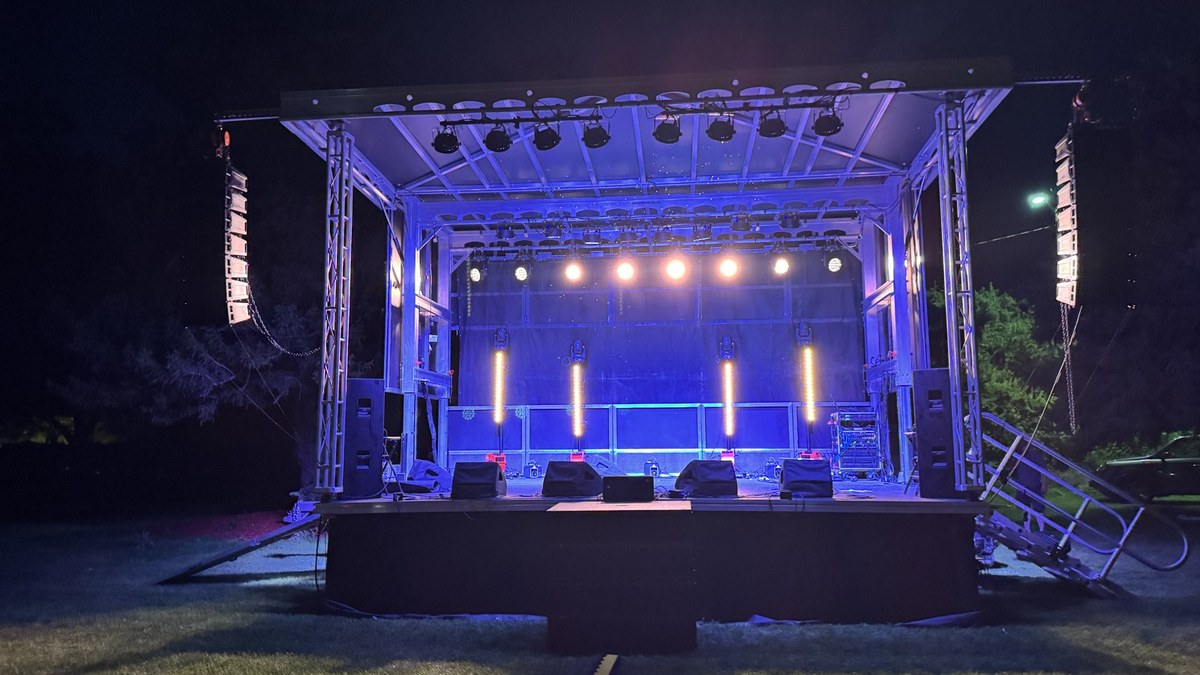
Full production earns its keep when the program is being recorded or streamed, when the room holds more than a few hundred people, when there is a recognition segment where names get read out loud, when more than one session runs at once, or when the space has no usable house system. That last one covers most outdoor sites, and most rotundas and atriums.
The rotunda case catches people. A beautiful stone room is a difficult acoustic room, and the house system in it, if there is one at all, went in for announcements.
Ask for the Scope in Writing
Whatever you decide you need, get it itemized. Not full production for one number, but the five lines above with a yes or a no written against each. A vendor who will not put that on paper is telling you something.
For large conferences, galas, and multi-day programs, six to eight weeks of lead time is what makes the planning worth anything. Shorter is workable for meetings and presentations. The value of the longer runway is not availability, it is the venue walkthrough, and the chance to solve the power and rigging questions on paper instead of on the loading dock.