The wireless mic that worked fine at your last event and keeps dropping out at this one probably isn't broken. It's sharing a channel with a TV station, and the TV station is winning.
Every wireless mic in the UHF band lives on the same frequencies as over-the-air television. Which channels are busy depends entirely on where you're standing, and Idaho is not one market. The Treasure Valley, the Magic Valley, eastern Idaho and the panhandle each have a different set of stations on the air, and a channel that's wide open in Twin Falls is a full-power ABC affiliate in Idaho Falls. Here's the map, region by region, as of September 2026.
A wireless mic doesn't fail because of bad luck. It fails because something louder is already on that frequency.
The Rules, in One Paragraph
Unlicensed wireless mics in the US are allowed on the TV band, which today means UHF channels 14 through 36 (470 to 608 MHz) plus the VHF channels, at up to 50 milliwatts. Two slivers just above that are also legal at 20 milliwatts, 614 to 616 MHz and 657 to 663 MHz. Everything else in the old 600 MHz range, 617 to 652 and 663 to 698 MHz, was sold to cell carriers and has been off limits since July 13, 2020. If your mic's label says something like 638 or 682 MHz, it's not legal to turn on anymore, and it will get stepped on by a phone tower before you finish the first toast anyway. The other rule that matters: you're supposed to stay at least four kilometers outside a TV station's protected coverage area on any channel it's using. In practice that means you don't set a mic on a channel that has a full-power station in the same city, ever.
How to Read the Map
The channel numbers below are the real transmitting channel, not the "Channel 7" you see on the remote. KTVB calls itself 7 but actually transmits on channel 23, which is why the number on your TV tells you nothing about your mic. Each TV channel is 6 MHz wide. A digital mic like the ULXD systems I rent needs a tiny slice of that, so one clear TV channel holds well over a dozen mics if you coordinate them, and one busy TV channel holds zero.
Red means a full-power station is on that channel in that market. Don't use it. Gray means only a low-power translator or repeater is there, which might be a problem at a venue two miles from the tower and a non-issue thirty miles out. White means nothing is licensed on it, which is where you start.
| Ch | MHz | Treasure Valley | Magic Valley | Eastern Idaho | Northern Idaho | Northern Utah |
|---|---|---|---|---|---|---|
| 14 | 470-476 | open | low | low | low | low |
| 15 | 476-482 | avoid | open | avoid | avoid | low |
| 16 | 482-488 | low | open | open | avoid | low |
| 17 | 488-494 | low | low | avoid | open | avoid |
| 18 | 494-500 | open | open | avoid | avoid | low |
| 19 | 500-506 | low | open | low | open | avoid |
| 20 | 506-512 | avoid | low | low | avoid | avoid |
| 21 | 512-518 | avoid | open | low | open | low |
| 22 | 518-524 | low | avoid | low | open | low |
| 23 | 524-530 | avoid | low | avoid | low | avoid |
| 24 | 530-536 | avoid | low | open | avoid | avoid |
| 25 | 536-542 | low | open | open | low | low |
| 26 | 542-548 | low | low | open | avoid | low |
| 27 | 548-554 | low | low | open | avoid | avoid |
| 28 | 554-560 | low | low | low | avoid | avoid |
| 29 | 560-566 | low | open | low | low | avoid |
| 30 | 566-572 | low | low | open | avoid | avoid |
| 31 | 572-578 | low | open | avoid | low | low |
| 32 | 578-584 | open | open | low | low | avoid |
| 33 | 584-590 | low | open | open | open | low |
| 34 | 590-596 | low | avoid | low | avoid | avoid |
| 35 | 596-602 | low | open | low | low | avoid |
| 36 | 602-608 | open | open | avoid | avoid | avoid |
Full-power station, avoid Low-power only, depends on the venue No TV signal licensed
Treasure Valley: Boise, Nampa, Meridian, Caldwell
This is the crowded one. Five full-power stations sit in the bottom half of the band: channel 15 (KKJB, Telemundo), 20 (KBOI), 21 (KAID, Idaho PTV), 23 (KTVB) and 24 (KIVI). Then a long run of low-power stations fills nearly everything from 25 up. Only four channels in the whole UHF band have nothing on them at all: 14, 18, 32 and 36.
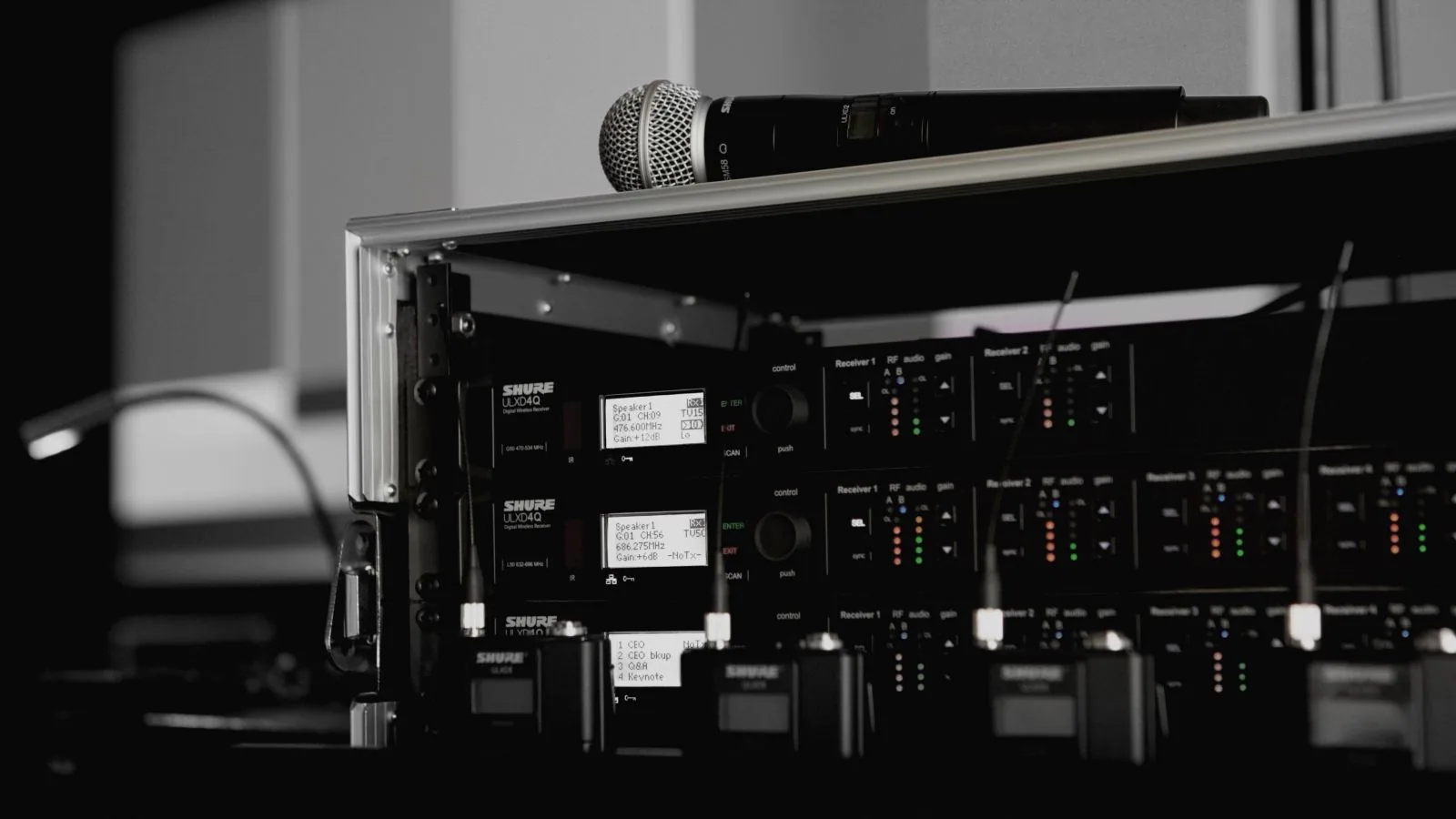
My ULXD handhelds, lavs and goosenecks are all G50 band, 470 to 534 MHz, which is channels 14 through 24. In the valley that means 14 and 18 are the two clean channels, and 16, 17, 19 and 22 are usable at most venues once you've confirmed the low-power stations aren't strong where you are. That's plenty for a corporate general session. It's tight enough that I don't guess. Every rack gets scanned at the venue before doors.
Magic Valley: Twin Falls, Jerome, Burley
The easiest RF in the state. Only two full-power stations, channel 22 (KIPT, Idaho PTV) and 34 (KXTF), and a dozen channels with nothing licensed at all: 15, 16, 18, 19, 21, 25, 29, 31, 32, 33, 35 and 36. Channel 14 has a Class A station in Twin Falls and a translator in Burley on it, so skip that one in town. Almost anything in the G50 band works here, and a quick scan at the venue will usually confirm it in under a minute.
Eastern Idaho: Idaho Falls, Pocatello, Rexburg, Blackfoot
Six full-power stations, and they sit right where the Treasure Valley's clean channels are. Avoid 15 (KPIF), 17 (KISU, Idaho PTV), 18 (KIFI), 23 (KPVI), 31 (KVUI) and 36 (KIDK). Channel 18, my favorite in Nampa, is the local ABC station in Idaho Falls. Bring a Boise setting to a Pocatello gala and you'll find out in the first ten minutes. The open channels are 16, 24, 25, 26, 27, 30 and 33, and for G50 gear that means 16 and 24 are your starting points, with 19 through 22 as low-power maybes depending on the venue.
Northern Idaho: Coeur d'Alene, Post Falls, Sandpoint, Moscow
The panhandle gets its television from Spokane, and Spokane is a real market with eleven full-power channels in use: 15, 16, 18, 20, 24, 26, 27, 28, 30, 34 and 36. What's left clean is 17, 19, 21, 22 and 33. Four of those five happen to be inside the G50 band, so a ULXD rack has room to work, but it has nothing to spare. Scan first.
Northern Utah, for the Record
I work Salt Lake and Ogden often enough that this belongs here. There is not one UHF channel between 14 and 36 with nothing on it. Every single one has a station, and thirteen of them are full-power. Working wireless in northern Utah means finding the low-power channels that are weak at your specific venue, and there is no shortcut for scanning on site. This is exactly why I run every mic through Wireless Workbench before a show instead of trusting a chart, including this one.
Renting wireless for an event outside the Treasure Valley? Ask at pickup and I'll happily show you how to scan for a clean frequency on the receiver. It takes about a minute.
Browse Wireless RentalsWhat This Means if You're Renting a Mic
If it's a 2.4 GHz system, like the Sennheiser XSW-D sets, none of the TV channel stuff applies. Those live in the same band as Wi-Fi and Bluetooth, hop around interference on their own, and are the right call for one or two mics at short range. They do not love a hotel ballroom with three hundred phones in it, which is why they're a party mic and not a conference mic.
If it's a UHF system, the channel it's on matters more than anything else about it. When you pick up from me, ask and I'll happily show you how to run the scan on the receiver so it finds a clean channel at your venue. If a mic starts dropping out mid-event anyway, scan again or move to one of the white boxes above for your region. On the ULXD gear that's a group and channel setting on the receiver, and the manual is in the case.
If you own a mic and the label says anything between 617 and 698 MHz, retire it. And if you're planning a big show, more than about four wireless channels at once, the picture changes completely: at that point the mics start interfering with each other, not just with TV, and the frequencies have to be coordinated as a set. That's a job I do with software, not a chart.
Check Your Own Address
This map is accurate for the market as a whole, and stations do move. The two tools I'd trust: RabbitEars.info lists every licensed station and the real channel it's transmitting on, market by market, and it's where the table above came from. Shure's free Wireless Frequency Finder does the same thing for a street address and spits out the open channels for a specific mic band. Mountain towns like Ketchum, McCall and Salmon get their TV from translators on channels that don't match the nearest big city, so for those, check the address, not the region.
And whatever a chart says, the scan on the day is the truth. Stations sign on, translators get added, and a venue next to a broadcast tower is its own situation. If you'd rather not think about any of this, that's a fair thing to hire out.