Most of my calls come from weddings and conferences. Some of my favorite jobs come from somewhere else entirely: fair boards, rodeo committees, race organizers, the person who got voted into running the demolition derby at the county fairgrounds. Those events live or die on their announcer, the crowd is spread across a space with no walls, and the person doing the booking has usually never had to book anything like it before.
This is the guide I wish those folks had before they started collecting quotes. Not the engineering, I've written that up separately. The practical part: what actually changes when the event is outdoors in an arena, what your site decides before any vendor can give you a real number, and the questions that tell you whether a sound company has done this before.
Indoors, the room helps carry the sound. Outdoors, the speakers do all of it, and every foot of distance has to be paid for.
An Arena Is Not a Big Ballroom
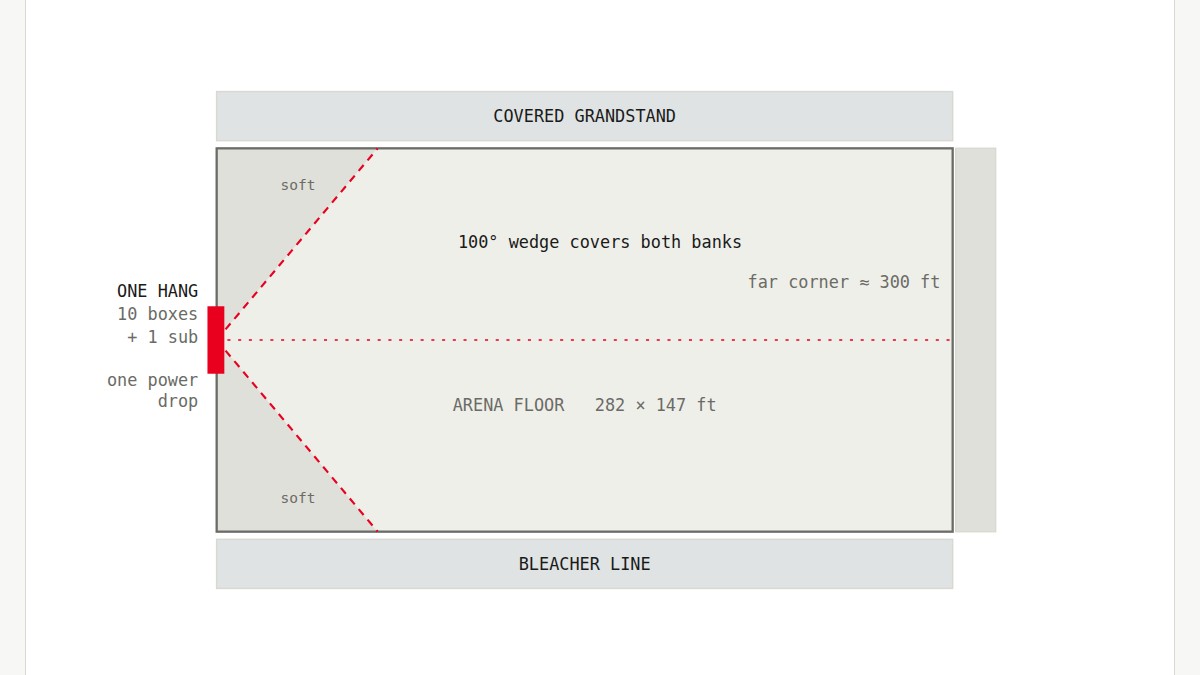
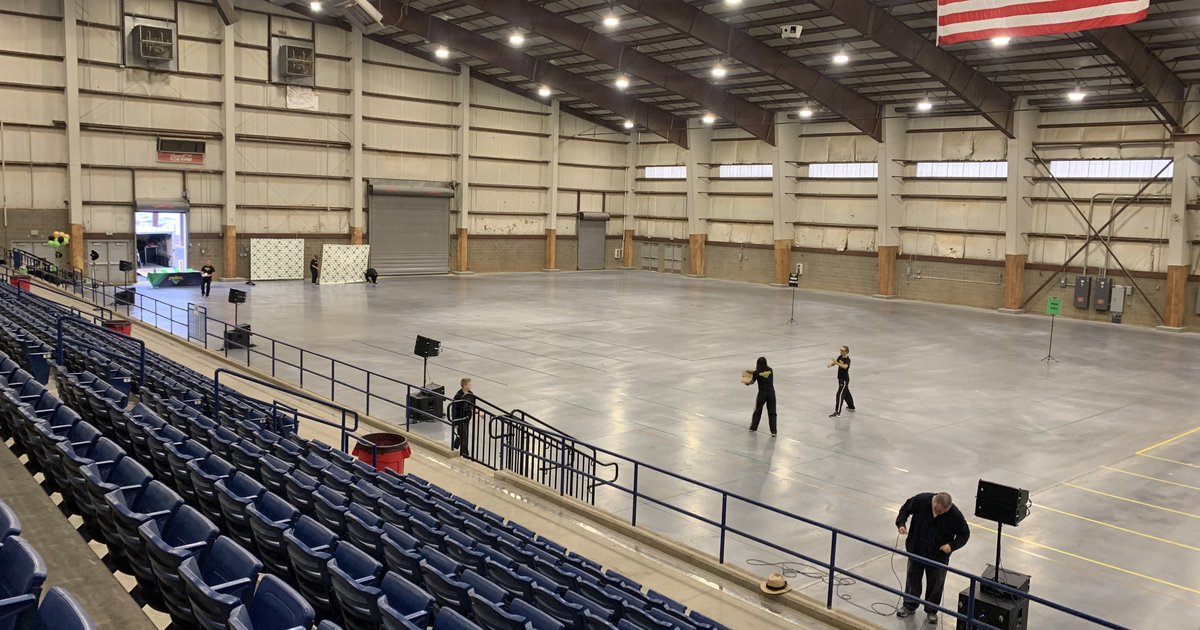
In a ballroom, the walls and ceiling bounce energy back into the audience, and the far seat might be 80 feet from the speakers. In an outdoor arena, nothing comes back. Working out coverage for the arena at Sandy Downs in Idaho Falls, the far corner of the seating sat about 300 feet from anywhere a speaker tower could reasonably stand. That distance changes everything about the equipment, and it's why the speakers that handled your cousin's wedding have no business at a grandstand.
It also means placement decides more than quantity. One properly aimed position usually covers a two-sided arena better than stacks spread around the grounds, which surprises almost everyone the first time they see it. I wrote up the full coverage math on that, with real numbers from a real arena, if you want to see why.
| A hotel ballroom | A fairground arena | |
|---|---|---|
| The far seat | 60 to 80 feet away | 250 to 300 feet is normal |
| What the room gives you | Walls and a ceiling carry part of the load | Nothing comes back, the speakers do all of it |
| Power | Wall outlets everywhere | One panel somewhere, or a generator |
| Weather | None | Wind, rain, dust, and heat all get a vote |
| The schedule | One evening | Gates open early, often multiple days, and livestock and machinery share the grounds |
The Announcer Is the Show
A wedding needs music first and speech second. A rodeo is the opposite. The announcer carries the event: he's reading sponsors, keeping the crowd with what's happening in the dirt, and making the safety calls that everyone genuinely needs to hear. If the music drops out for ten seconds, nobody remembers. If the announcer turns to mush in the grandstand, the event stops working.
The mic list for most rodeos and fairs is shorter than people expect: the announcer, a judge or chute boss, somebody for the anthem, and playback for music between events. The channel count is modest. The standard it has to hit is not, because those mics work all day, in dust, next to livestock and engines. On shows I run, every wireless channel gets scanned and coordinated at the venue before gates open, so a dropout doesn't get to pick its own moment.
Your Site Decides the Quote Before I Do
Two rodeos with identical programs can need very different systems, and the difference is almost never the event. It's the site. Three things matter most.
Power. Where it is, and what it is. A panel at the announcer's stand is one job. A generator 200 feet from where the speakers need to stand is a different one, with different cable and different planning. You don't need to know what any of it means. You just need to find out what the grounds actually have and where it lives, because guessing is how events end up with a breaker tripping during the main event.
Access. Equipment that covers a grandstand arrives in a truck and goes up on a lift. There has to be a route to the speaker position that a loaded vehicle can actually drive, and ground firm enough to park a lift on. A gate that's locked on load-in day, or a position that's only reachable across soft dirt, costs hours.
The position itself. Somewhere a tower can stand without blocking sightlines, stock traffic, or the pathways the fair needs. This gets settled with a map before the event, not an argument during load-in.
Wind, Weather, and Dust
Wind moves sound. A steady afternoon crosswind can push coverage off the seats it was aimed at, and anything flown on a lift gets planned around wind from the start, including the wind speed where the right call is bringing it down. Rain is simpler: consoles and amplifiers need cover, and that cover has to exist before the sky decides. Dust is the one nobody budgets for. An arena being worked puts grit in the air all day, and gear that lives outdoors all weekend has to be built and maintained for it.
None of this cancels events. All of it has to be planned instead of discovered, and the planning is invisible on a sunny day, which is exactly how it should be.
Curfews and Neighbors
A lot of fairgrounds that used to sit outside town now have neighborhoods against the fence. Before you book a band or set an evening schedule, ask the venue for its sound policy and curfew in writing. Aiming the system into the seats instead of across the property line is most of the battle, and the schedule does the rest. If there's a hard cutoff at ten, the headliner's set time matters more than anything on the equipment list.
Six Questions to Ask Any Sound Vendor
You don't need to speak audio to sort the real companies from the hopeful ones. These six questions do it for you.
- Where will the speakers go, and why there? A specific answer about aim and distance is a good sign. "A stack on each side" without a reason is not.
- What do you need from our power, and what happens if we don't have it?
- What's the plan for wind and rain, for the gear and for the schedule?
- Who is behind the console during the show, and is that person in the quote?
- What's the backup if a mic or an amplifier dies mid-show?
- When do you load in, when are you out, and does that fit the grounds schedule?
Any company that's covered a grandstand before will answer all six without blinking. A company that hasn't will get vague around the third one, and it's much better to find that out on the phone than on opening day.
What to Have in Hand When You Call
Six things get you a real number instead of a range: your dates and the daily schedule, a map or aerial photo of the grounds, where the seating is and roughly how much of it there is, where the power lives, who needs a mic, and whether music runs between events. Events like these are priced item by item rather than from a package menu, so the more of that list you can answer, the faster the quote gets specific.
On timing: multi-day and outdoor events get planned earliest, so the right time to call is as soon as your dates are set. For anything big, 6 to 8 weeks out is the comfortable window. And if you're reading this with three weeks to go, call anyway. A tight timeline quoted honestly beats assuming it's too late.
Running a rodeo, a fair, or anything with a grandstand? Send me the grounds map and the schedule, and the quote comes back specific, not a range.
See Live Event Sound